
OEM vs Compatible Cleaning Blades for OKI: A Distributor's Buying Guide
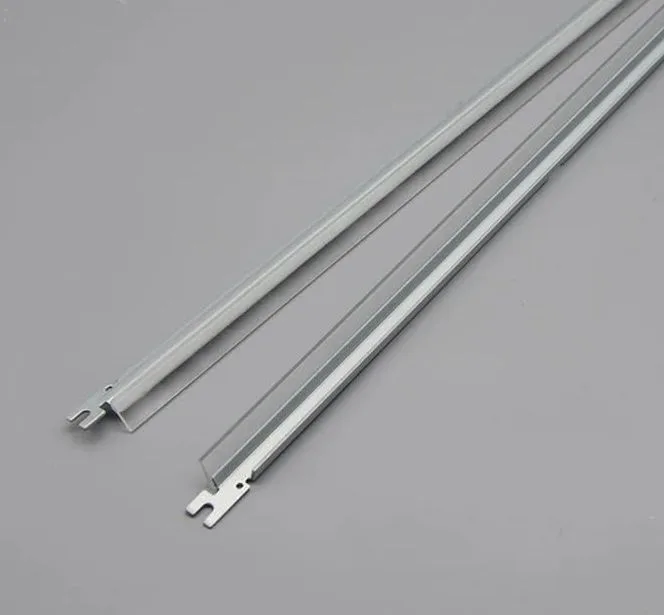
Cleaning blades are the cheapest part in an OKI drum unit and the one that decides whether a customer comes back angry or comes back to reorder. Distributors who treat them as a commodity line get burned by wiper streaks, torn edges and toner scatter on MC800 and C800 series machines, then spend weeks on credit notes. The OEM-versus-compatible question is really a question about edge geometry, urethane hardness and how honestly your supplier tests before shipping.
What the cleaning blade actually does on an OKI drum unit
On OKI's LED-based engines — C301dn, C332dn, MC342dn, the C800/MC800 workgroup boxes and the C900 heavy-duty range — the cleaning blade wipes residual toner off the OPC drum after transfer. It sits under spring or screw tension at a fixed contact angle, and it has to hold that angle across tens of thousands of pages without chattering. Get the urethane durometer wrong and you get one of two failures: too soft and the edge curls, letting toner past to print as a grey band on the next page; too hard and the blade scrapes the drum coating, which shows up as fine longitudinal scratches and eventually a repeat-mark every drum circumference.
The OEM blade is matched to a specific drum coating and toner formulation. OKI has changed drum coatings across generations, and a blade that performs perfectly in a C332 drum can squeal and flip in an MC800 unit. Any compatible supplier worth talking to will know this and hold separate tooling or at least separate urethane batches per drum family. Ask them directly which OKI drum families they tool for and whether the blade profile is copied from a tear-down or reverse-engineered from drawings. The answer tells you a lot.
Where compatible blades fail — and how to spot it before you stock
Most compatible blade complaints trace back to three things: edge finish, urethane consistency and storage. A moulded edge with micro-flash will not wipe cleanly; it needs a precision ground or laser-trimmed lip. Batch-to-batch urethane variation shows up as inconsistent blade pressure, which technicians notice as squealing or as toner filming on the drum after a few thousand pages. And blades stored flat under other cartons take a set that never recovers.
When you evaluate a sample, do not just fit one blade and print a test page. Run a short bench test that mirrors real field conditions. Fit the blade to a used drum with known page count and print 200 pages of 5% coverage, then inspect the drum for filming and the blade edge under a loupe for nicks. Check edge straightness against a steel rule — any visible wave means the lip was cut from a badly tensioned sheet. Measure durometer on three blades from the same batch; a spread of more than 3 Shore A points is a red flag. Leave one blade compressed in its packaging for a week, then fit it — if it chatters, the urethane is taking a set. Confirm the mounting holes and locating tabs align without forcing; a blade that needs to be levered into place will sit at the wrong angle.
Do this once per batch code, not once per supplier relationship. Compatible quality drifts, and the batch you approved in January is not necessarily the batch arriving in June.
OEM blades: when the premium is justified
OEM OKI blades make sense in two situations. First, contract and tender business where the end customer specifies genuine consumables and your margin is protected by the specification. Second, high-volume MC800 and C900 fleets where a single callback costs more than the price difference on a carton of blades. In those accounts, the OEM blade's consistency is the product — you are buying predictable drum life, not just a strip of urethane.
The problem for distributors is availability and price ladder. OEM blades often ship only as part of a drum unit or in pack quantities that don't match how repair shops actually buy. That pushes smaller accounts toward compatible supply whether you stock it or not. Better to have a tested compatible line on your shelf than to lose the account to whoever does.
Buying compatible blades factory-direct: what to lock down
The economics of compatible blades only work when you buy close to the source. Every hand between the moulding machine and your warehouse adds cost and adds a storage step where blades get compressed. Factory-direct purchasing lets you specify the urethane grade, the edge finish and the packaging — blades should ship in rigid trays or on edge, never loose in a poly bag under a carton of drums.
Insist on batch traceability. A serious manufacturer will mark batch codes on the blade or inner pack so you can isolate a bad run without scrapping your whole stock. Ask for a first-article inspection report covering durometer, edge profile and dimensional check against the OEM reference, and ask whether they will hold that spec across reorders. Also clarify the ODM option: if you distribute under your own brand, you want the tooling and packaging to be yours, with the same batch controls behind it.
CLONER manufactures cleaning blades and drum-unit components factory-direct, with OEM and ODM programmes for distributors who need OKI-compatible profiles under their own label. We tool per drum family, hold urethane batches to a measured durometer window, and ship blades in rigid packaging with batch codes so a field complaint can be traced to a run rather than a whole container. Send us the OKI models you move most and we will quote against your volume with sample blades for your own bench test before you commit to a stocking order.
Need a quote or samples from CLONER?
Factory-direct OEM/ODM supplier of compatible printer consumables & spare parts. Tell us your models — reply within 24h.


