Buying Drum Chips for Samsung Copiers: A Repair Shop Field Guide
Every repair shop that services Samsung mono lasers knows the pattern: a machine that ran fine for 40,000 pages starts throwing a drum unit warning, the customer blames your last service, and you eat the labour. Nine times out of ten the culprit is a drum chip that either wasn't the right variant or wasn't built to hold its data. Buying these chips well is less about price per piece and more about knowing which board revision sits in the machine in front of you.
Know Which Samsung Drum Family You Are Feeding
Samsung's consumable architecture changed several times across the ML, SCX, and Xpress lines, and the drum chip is tied to the controller, not just the cartridge shape. A chip pulled for an ML-2160/2165 drum will not behave correctly in an SCX-3405 even though the physical drum units look nearly identical on the bench. The Xpress M2020/M2070 series and the later M2830/M2880 family use different data layouts again, and the colour CLP and CLX machines add a second wrinkle because each colour drum carries its own chip with colour-specific coding.
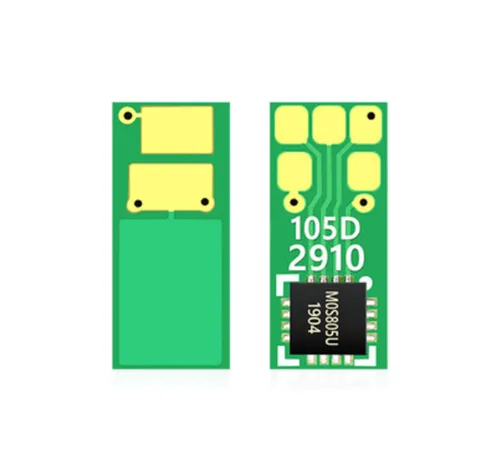
Before you place a bulk order, pull the actual drum units from your three or four most common machines and photograph the chip footprint, the contact pad layout, and any laser-etched batch code. Send those photos with your PO. A supplier who cannot match a board revision from a clear photo is a supplier who will ship you a "compatible" chip and let you discover the mismatch at the customer's office. Build a simple cross-reference sheet by machine series, drum part number, and chip variant, and keep it on the bench wall.
What Actually Goes Wrong With Cheap Drum Chips
The failures are consistent. The most common is a chip that reads correctly on first install and then fails to reset the page counter after the drum is replaced, so the warning returns within a few hundred pages. The second is unstable data retention under heat: a chip that tests fine cold will drop its stored values after an hour inside a warm machine, and the customer sees a "replace drum" message on a unit you just fitted. The third is contact corrosion, usually from thinly plated pads that oxidise in humid storage.
There is also the counterfeit problem. Genuine-looking Samsung-branded chips circulate widely, and some are relabelled rejects. If a broker offers original chips at a fraction of the dealer price with no traceable batch, treat it as a relabel until proven otherwise. For repair shops, the practical rule is to buy from a manufacturer who will state the chip type, the memory behaviour, and the machine list in writing, and who will replace failed units without an argument.
Bench Testing Before You Fit a Batch
Do not fit a new batch straight into a customer machine. Pull one drum from each carton and run it through a known-good chassis on the bench. Confirm the machine accepts the chip, that the drum life counter resets to full, and that the warning does not return after a forced power cycle and a short print run. Then leave that unit powered for an hour and check the status again, because heat-related data loss will not show up in a two-minute test.
Inspect the physical chip as well. Look for even plating on the contact pads, clean edges on the board, and a legible batch or date code. Reject cartons where chips sit loose in the bag or where the protective film has already been removed. Keep a log of batch codes against failure rates; after two or three orders you will know which batches to reorder and which to avoid. This log is also your leverage in a warranty claim.
Ordering Terms That Protect a Repair Shop
Volume buyers should be specific about what they are buying. State the machine series, the drum part number, and the chip variant on the PO, and require the supplier to confirm the match in writing before shipment. Ask for a failure rate commitment and a replacement policy that covers chips which pass on arrival but fail within the first few hundred pages, since that is where most of your comebacks come from.
Packaging matters more than it seems. Chips should arrive in anti-static bags with the contacts protected, in cartons that will survive a courier journey. If you are buying for a distributor or a chain of shops, ask for individual bagging and machine-specific labelling so your counter staff do not have to sort by hand. And confirm lead times on the specific variants you use most, because a cheap chip that arrives three weeks late costs you more than a slightly dearer one that ships this week.
- PO must list machine series, drum part number, and chip variant
- Written confirmation of compatibility before shipment
- Replacement cover for early-life failures, not just dead-on-arrival
- Anti-static bagging and machine-specific labels
- Batch code on every carton for your failure log
Where CLONER Fits
CLONER manufactures drum chips and related consumable electronics at our own factory, so the batch you buy in March is built to the same specification as the batch you bought in January. We supply repair shops and distributors directly, which means you deal with the people who control the production line rather than a broker two layers removed from it. For shops with steady Samsung volume, our OEM and ODM service covers custom labelling, machine-specific packaging, and chip variants tuned to the series you service most.
Send us your machine list and a photo of the chip footprint from your most common drum unit. We will confirm the variant, quote factory-direct pricing by quantity, and ship samples for your bench test before you commit to a carton. That is the whole process, and it is the same one we use with distributors in more than thirty markets.