Buying Drum Chips for Samsung Copiers: A Repair Shop's Field Guide
Most drum chip problems in a Samsung copier don't announce themselves as chip problems. You get a faint background band, a toner-low warning that resets itself, or a machine that runs 300 pages and then throws a replace-drum prompt it shouldn't. The shop blames the drum unit, swaps it, and the fault follows the chip. Buying these parts well is less about price per piece and more about knowing which Samsung families punish a cheap chip and which tolerate it. That distinction separates a clean install from a callback.
Know Which Samsung Families You're Actually Buying For
Samsung's copier line splits into distinct chip behaviours, and suppliers who lump them together are telling you something. The older SCX-4200/4300 and ML-2010-class mono machines use relatively simple drum/toner CRUMs that are forgiving on contact tolerance but strict on the initial data string. The K2200, K3250, K3300 and multi-function Xpress C-series colour boxes are a different animal: the drum chip handshakes with the main board, logs page counts, and on colour units ties into the imaging unit's colour registration. Get the data string slightly wrong and the machine may accept the chip but never clear the drum-life counter.
Before you order, map your actual service base. A shop doing contract maintenance on K2200 and K3250 fleets needs chips that survive repeated power cycles and firmware that has been updated in the field. A shop refurbishing SCX-4650 and ML-2850 units for resale has different priorities: consistent reset behaviour and clean physical contacts, because the end buyer will install it cold. Ask any supplier to state which model families a given chip SKU covers and whether the firmware revision matters. Vague answers about "Samsung compatible" are a warning, not a feature.
Firmware is the quiet killer. Samsung pushed updates through the 2018–2020 window that changed CRUM validation on several K-series and C-series engines, and chips programmed to older logic can read as invalid after an over-the-air or USB update. A serious supplier tracks these revisions and can tell you the production date after which their stock handles current firmware. If they can't, you're buying a batch that may work in your bench test and fail at the customer's site.
Inspection Points That Catch Bad Batches Early
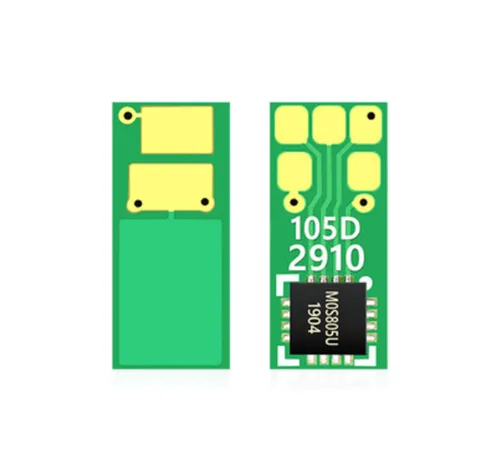
You can't fully test a drum chip without a machine, but you can reject obvious junk before it reaches a copier. Start with the PCB itself: the contact pads should be gold-plated or at least consistently tinned, not dull or unevenly coated. Look at the chip module seating — a package that sits proud or tilted will lose contact when the drum unit flexes during rotation. On Samsung units where the chip mounts to a small bracket, check that the bracket geometry matches the OEM part; a chip that needs force to seat is a chip that will fail in the field.
Then run a small incoming sample on real hardware. Install, power cycle three times, print 50 pages, and confirm the drum-life counter reads full and the machine doesn't re-prompt. Do the same on a second engine of the same family if you have one, because board-level tolerance varies. Note whether the chip survives a mid-cycle power interruption — a surprisingly common failure mode on cheap Samsung-compatible CRUMs is losing its stored data when the machine cuts power during warm-up.
- Gold or even tinning on all contacts, no oxidation or solder splash
- Module flush and square in its seat, bracket geometry matching OEM
- Drum-life counter reads full after install and survives three power cycles
- No re-prompt after 50–100 pages on two engines of the same family
- Data survives a power cut during warm-up
Track failure rate by batch, not just by SKU. If one lot shows 3–4% returns on K3250 while the previous lot was clean, that's a programming or component change, and you should push the supplier for a production date and lot number. Suppliers who can't trace a lot can't fix a batch.
What Separates a Real Factory Supplier From a Repackager
Many vendors selling Samsung drum chips are repackagers buying from the same handful of programming houses. That's fine if they add inspection and warranty, but it means their technical depth is borrowed. Ask where the chips are programmed and whether the supplier controls the firmware data themselves. A factory-direct source can adjust the data string for a specific model family, run burn-in on a sample, and tell you the IC and PCB spec without translating through a trading company.
Warranty terms tell you how much the supplier trusts the batch. Reasonable terms for drum chips are a replacement policy on documented failures with a defined claim window, and a willingness to credit a proven bad lot rather than argue piece by piece. Watch for suppliers who price per piece aggressively but exclude chips from any return once the bag is opened — that structure shifts all the batch risk onto your bench.
Packaging and documentation matter more than they seem. Chips shipped loose in a bag with no lot marking are hard to trace and easy to mix. Look for anti-static packaging, a lot or date code, and a model-family label that matches what you ordered. If you're buying for multiple Samsung families, colour-coded or clearly labelled bags save mis-installs on a busy bench.
Ordering Strategy for Shops and Distributors
Don't buy a year of stock on an unproven SKU. Run a first order sized to your monthly consumption for the top two or three Samsung families you service, install the full sample across real jobs, and only then scale. Keep a small buffer of your highest-failure SKU so a bad batch doesn't stall contract maintenance, and rotate stock so older lots get used before firmware drift makes them riskier.
For distributors, the economics shift toward OEM/ODM arrangements: your own labelling, agreed data-string coverage across a model list, and consistent lot traceability. That's where a factory relationship pays off, because you can specify the Samsung families you sell into and get chips programmed and packed for that mix instead of taking a generic assortment. Negotiate lead time and minimum order against your actual sell-through, and ask for a sample run before committing to a production batch.
CLONER manufactures drum chips and copier consumables factory-direct, with OEM/ODM support for buyers who need specific Samsung model coverage, their own branding, and traceable lots. Send us your service mix and firmware concerns, and we'll quote a sample batch programmed for the families you actually run — then you can bench-test before you commit volume.
Need a quote or samples from CLONER?
Factory-direct OEM/ODM supplier of compatible printer consumables & spare parts. Tell us your models — reply within 24h.