OEM vs Compatible Cleaning Blades for Siond: A Distributor's Sourcing Playbook
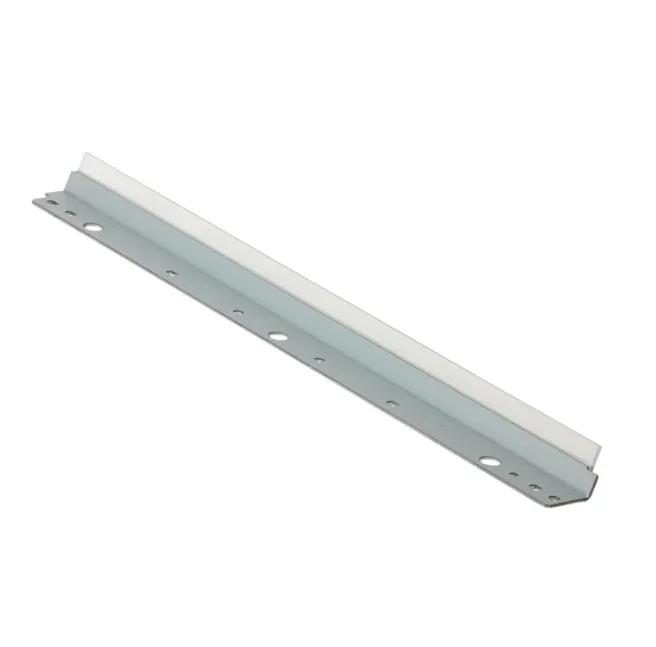
You've seen the price gap. OEM Siond cleaning blades run $3–$5 per piece. Compatible versions from China land at $0.60–$1.20. That 4x spread isn't branding. Pick the wrong blade and you're looking at comebacks, scratched drums, and a distributor reputation that takes years to rebuild. Here's what actually matters when you're comparing options.
What the OEM Blade Really Gets You
Siond's OEM cleaning blades are molded from a specific polyurethane compound—typically 70–75 Shore A hardness—with a die-cut edge machined to ±0.05mm tolerance. That edge geometry is the whole game. It has to sit flush against the drum at a precise angle, usually 20–25 degrees, to scrape residual toner without gouging the OPC layer. OEM blades also come with a pre-applied dry lubricant, often PTFE-based, that reduces friction during the first 5,000 prints. Skip that lubricant and you'll see drum wear accelerate within a week.
The downside is pricing and lead time. OEM blades assume you're buying through authorized channels. For a distributor moving 500 units a month, that's $1,500–$2,500 in blade costs alone. And lead times from Siond's official parts network can stretch to 4–6 weeks if stock sits in Europe or North America.
Where Compatible Blades Win—and Where They Fail
A good compatible blade from a factory like CLONER uses the same 70–75 Shore A polyurethane, but the edge is often hot-pressed rather than die-cut. That's fine if the tooling is fresh. Problems start when molds wear out. After 50,000–80,000 cycles, the edge angle drifts, and you get a blade that either chatters (leaving streaks) or over-scrapes (scoring the drum). Most cheap blades on the market come from tooling that's past its prime.
Another failure point: the mounting bracket. OEM brackets are stamped steel with a zinc coating. Some compatible suppliers use bare steel or thinner gauge metal. On Siond models like the SF-2030 or SF-2530, a warped bracket means the blade doesn't seat evenly. You'll see uneven wear—one side clean, the other leaving a 2mm toner trail. That's a dead giveaway during incoming inspection.
Incoming Inspection: What to Check Before You Pay
Don't trust a spec sheet. Demand a 50-piece sample and run these checks:
- Edge straightness: Place the blade on a granite surface plate. Any gap over 0.1mm across the length means the tooling is worn.
- Hardness test: Use a Shore A durometer on the rubber tip. Readings below 68 or above 78 are out of spec.
- Bracket flatness: Check with a feeler gauge. More than 0.15mm warp will cause uneven contact.
- Lubricant presence: Wipe the edge with a white cloth. If it comes back dry, the blade will wear the drum prematurely.
- Packaging: Individually bagged blades with a desiccant pack. Bulk-packed blades oxidize and harden in transit.
Run a 10,000-print test on a used drum. Pull the blade and inspect the edge under a 10x loupe. You want a uniform wear line—no chips, no glazing. If the edge looks polished like glass, the compound is too soft.
Pricing, MOQs, and OEM/ODM Realities
Factory-direct compatible blades from CLONER run $0.70–$1.10 per piece at 1,000 units, dropping to $0.55–$0.80 at 5,000 units. OEM equivalents from Siond authorized distributors are $3.20–$4.50. For a distributor selling to repair shops, that margin difference is your business. But don't chase the absolute lowest price—a $0.40 blade usually means recycled polyurethane or a worn mold.
If you want your own brand, OEM/ODM is straightforward. CLONER can mold blades to your specified hardness (68–80 Shore A), cut to your edge angle, and print your logo on the bracket. MOQ for custom tooling is 10,000 pieces, with 25–30 day lead time. For standard Siond-compatible blades, MOQ is 500 pieces, shipped in 7–10 days from our factory. We keep molds for SF-2030, SF-2530, SF-3030, and SF-4030 in rotation, so you're not waiting on a new tool run.
Matching Blade to Drum Condition
One last thing distributors often miss: blade selection depends on the drum you're pairing it with. A new OEM drum can take a slightly harder blade (75–78 Shore A) because the OPC layer is thick. A refurbished drum with 50% life left needs a softer blade (68–72 Shore A) to avoid scratching. If you're selling to repair shops that mix new and used drums, stock both hardness ranges. CLONER color-codes the bracket—blue for soft, black for standard—so your customers can grab the right one without guessing.
We ship from our own plant, not a trading company. That means you can request a pre-shipment sample from the exact batch you're buying, and we'll hold the container until you approve. For distributors moving 2,000+ blades a month, we'll also set up a consignment stock in your region. No middlemen, no surprise spec changes.