Compatible OPC Drums for Sharp Copiers: How to Source, Inspect, and Save Without Sacrificing Yield
If you're stocking compatible OPC drums for Sharp copiers, you already know the margins can be solid—but only if the drums actually hold up. Sharp’s AR, MX, and SF series use a range of OPC drums that are notoriously sensitive to coating quality and charge uniformity. A cheap drum that prints 20,000 pages instead of 60,000 will eat your profit and your reputation. So before you place that next order, here’s what to look for, what to test, and how to buy smart.
Know Your Sharp OPC Families
Sharp has used several OPC drum generations across their lines. The older AR-200/205/206 series (AR-200DR, AR-205DR) are 30mm diameter drums with a simple two-piece flange. The MX series—MX-2310, MX-3110, MX-4100, MX-5001—use larger 30mm drums with a gear on the rear flange, but the coating specs differ. The newer SF series (SF-S245, SF-S305) uses a 30mm drum with a different charge roller and cleaning blade setup. If you’re not matching the exact drum for the model, you’ll get charge leakage or poor transfer.
One common mistake is assuming all 30mm Sharp drums are interchangeable. They’re not. The flange design, the position of the drive gear, and the surface roughness all vary. For instance, MX-2310 drums have a smooth rear flange, while MX-4100 drums have a gear that also acts as a coupler. Order the wrong one and you can’t even install it. Always cross-reference the OEM part number (e.g., MX-231CV, MX-410CV) against your supplier’s list, and don’t rely on “universal” claims.
What to Inspect on a Compatible OPC Drum
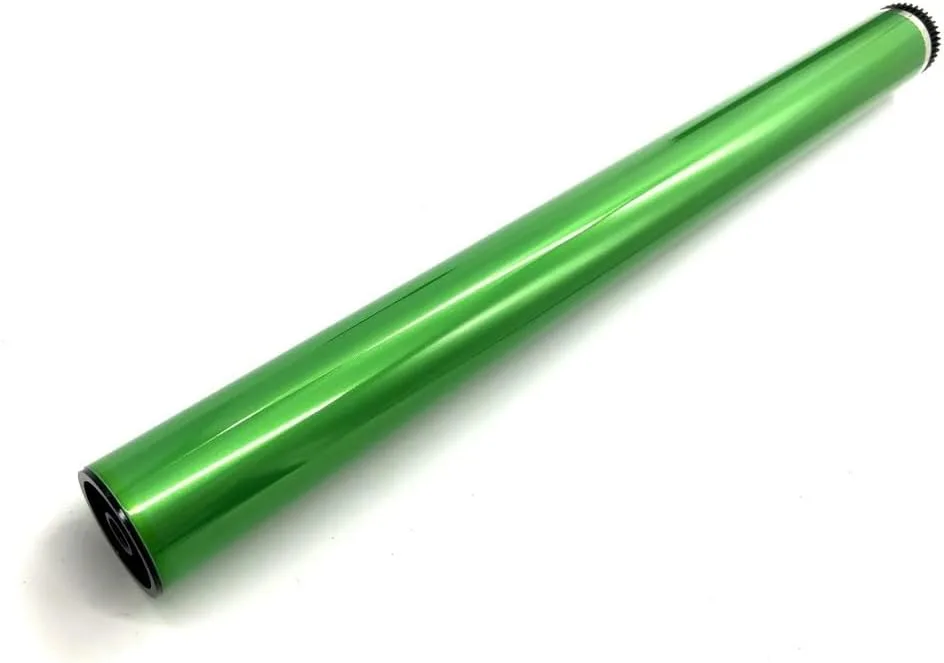
When you receive a batch of compatible drums, don’t just check the packaging. Take a drum out and look at the surface under a bright light. You’re checking for three things: scratches, pinholes, and coating uniformity. A scratch that’s visible to the naked eye will cause a white line on prints. Pinholes—tiny dots where the coating is missing—show up as periodic black dots. And if the coating has a mottled or streaky appearance, you’ll get inconsistent charge and ghosting.
Also inspect the flanges and the gear. The flange should fit snugly on the drum core, with no wobble. The gear teeth should be clean and free of burrs. A slightly oversized gear can bind in the copier, causing a grinding noise and premature drive failure. And check the cleaning blade contact area—if the drum has a wear band where the blade sits, it’s been used or poorly handled. That’s an immediate reject.
One practical test: use your fingernail to gently press on the drum surface. A good OPC layer has a slight give, but it should not dent or flake off. If it flakes, the coating is too brittle—that drum will fail within the first 5,000 pages. If it dents, the coating is too soft—it will wear unevenly.
How to Test a Sample Before Bulk Ordering
Before you commit to a large order, run a sample drum in a machine you know is in good condition. Install it, run a solid black print, a halftone, and a 10% coverage page. Look for density uniformity—any light or dark bands across the page indicate charge issues. Then run a blank page to check for background fog, which suggests the OPC is not holding charge properly. Finally, run 1,000 pages and re-check the same patterns. If the drum holds up, it’s likely good.
But here’s the insider part: test the drum in the same environmental conditions your customers will use it. OPC drums are sensitive to humidity. If you’re in a high-humidity climate, the drum’s charge retention drops. Some compatible drums use a different charge transport layer that’s more humidity-resistant. Ask your supplier if their drum has been tested in high RH. CLONER, for example, runs QC in a controlled environment and can provide humidity test data on request.
Yield and Cost: What You’re Really Paying For
Sharp’s OEM drums are rated for 60,000 to 100,000 pages depending on the model. A good compatible should hit at least 80% of that. But yield depends on the OPC layer thickness and the quality of the charge roller. Cheaper drums often have a thinner coating to save cost, which cuts yield in half. You’re not saving money if you’re replacing drums twice as often—and you’re losing labor time and customer trust.
When comparing prices, look at cost per page, not just unit price. A $15 drum that lasts 40,000 pages is a better deal than a $10 drum that lasts 20,000. Also factor in the risk of downtime. If a drum fails early, you might have to send a tech out, which costs you $50–$100 in labor. That wipes out any savings.
CLONER’s factory-direct pricing lets you buy at OEM-like quality without the brand markup. Our Sharp-compatible OPC drums are made on the same production lines as our OEM contracts, using the same coating formulas. We offer OEM-ODM options if you want your own brand on the box—many of our customers do that to build a private label line.
Ordering and Logistics: Getting It Right
When you order compatible OPC drums, you need to think about packaging and shelf life. OPC drums are light-sensitive. They should be shipped in opaque, sealed bags with a desiccant. If they’re exposed to UV light for more than a few minutes, the coating degrades. Check that your supplier uses proper light-proof packaging. CLONER uses double-layer aluminum foil bags with a desiccant pouch, and we can customize the packaging for your market.
Also consider lead time and MOQ. If you’re a wholesaler, you don’t want to hold too much inventory because OPC drums have a typical shelf life of 18–24 months. But you also don’t want to run out. CLONER offers flexible MOQs and can schedule production to match your sales forecast. We can also drop-ship direct to your customers if you need that flexibility.
Finally, don’t overlook the flange and gear quality in your ordering specs. Some suppliers use recycled flanges to cut costs. That’s a red flag—recycled flanges can have micro-cracks that cause the drum to slip or wobble. Ask your supplier if their flanges are new or recycled. At CLONER, everything is new, and we can provide a material certificate on request.
If you’re tired of inconsistent compatible drums, consider going factory-direct. CLONER manufactures OPC drums for Sharp and other major brands, and we’re happy to work with you on OEM-ODM projects. You get consistent quality, competitive pricing, and a partner who understands the technical side. Send us a sample of the OEM drum you’re using now, and we’ll match or beat its performance—at a price that makes sense.
Need a quote or samples from CLONER?
Factory-direct OEM/ODM supplier of compatible printer consumables & spare parts. Tell us your models — reply within 24h.