How to Check Samsung Copier Pickup Roller Quality Before You Buy
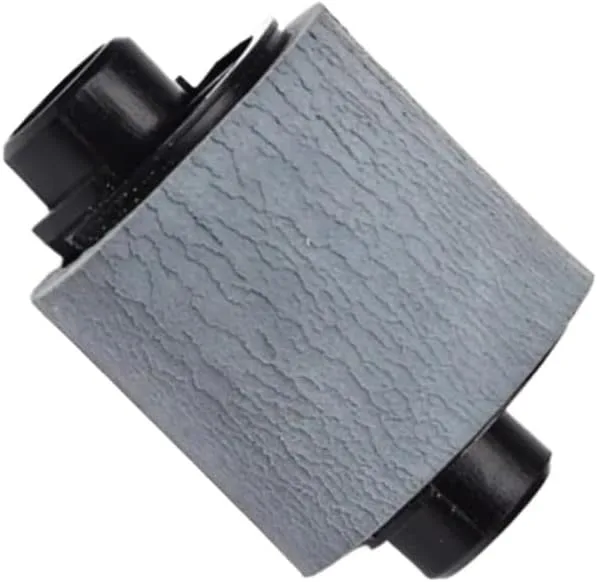
You've probably had a batch of Samsung pickup rollers that looked fine in the box but started misfeeding within 8,000 pages. The cost isn't the roller—it's the service call, the angry end user, and the return shipping. Most quality problems trace back to three things: rubber compound, gear tolerance, and storage conditions. Here's how to catch them before you commit to a container.
Check the Rubber Compound, Not Just the Color
Pickup rollers for Samsung models like the SCX-4200, ML-2160, and CLP-365 series live in a narrow durometer window—typically 55–65 Shore A. Too soft and the roller deforms under spring pressure, causing double-feeds. Too hard and it glazes, losing grip after 15,000–20,000 picks. Ask your supplier for a durometer reading on the actual production batch, not a lab sample. CLONER runs a Shore A check on every molding lot; if a supplier can't produce that number, walk away.
Color is a weak indicator. Black rollers can be EPDM or nitrile; gray ones are often silicone-coated. What matters is compression set—how much the rubber fails to return after being squeezed. A good roller recovers within 5% after 24 hours at 70°C. Cheap rollers take a permanent flat spot, and you'll see misfeeds on the first paper tray position. Request a compression set report if the order is over 5,000 pieces.
Inspect the Gear and Shaft Fit
The pickup roller gear on Samsung CLX-3300 and SL-M2020 series is a weak point. A gear molded with recycled POM will crack at the hub after a few hundred cycles, especially in low-humidity environments. Look for a clean parting line, no flash, and a gear tooth profile that matches the OEM spec within 0.05 mm. Roll a sample gear against a known-good OEM gear—if you feel binding or hear a click, the mold is worn.
Shaft fit matters just as much. The roller should slide onto the pickup shaft with light finger pressure but not wobble. A loose fit causes the roller to slip on the shaft, which mimics a feed problem and sends technicians chasing the wrong part. Measure the inner diameter with a pin gauge. For most Samsung models, the spec is 6.0 mm +0.05/-0.00. If the supplier can't tell you the ID tolerance, they're not molding to print.
Test for Static and Paper Dust
Static buildup is the silent killer of pickup rollers. In dry offices, a roller with high surface resistivity attracts paper dust, which polishes the rubber and reduces friction. A simple bench test: rub the roller with a lint-free cloth for 10 seconds and see if it lifts paper scraps. If it does, the compound lacks anti-static additive. This is common in rollers that use cheap carbon black filler.
Paper dust also tells you about surface finish. A good pickup roller has a slightly matte texture—not shiny. Shiny means the mold was polished too much or the rubber has a high plasticizer content. Plasticizer migrates to the surface over time, creating a slick film. If you're buying for a hot climate, ask for a heat-aging test: 72 hours at 80°C, then check for surface tackiness. Tacky rollers pick up dust and fail early.
Verify Packaging and Storage Conditions
Rubber parts have a shelf life. A pickup roller molded 18 months ago and stored in a non-climate-controlled warehouse will already be partially cured. Ask for the production date code on the bag. CLONER ships within 30 days of molding and uses foil-lined bags with desiccant for sea freight. If your supplier sends rollers in a plain poly bag with no date code, you're buying someone else's old stock.
Check for ozone cracking, too. Rollers stored near electric motors or in sunlight develop fine surface cracks that you can see under a 10x loupe. These cracks grow into chunks missing from the roller edge. A quick visual inspection of the batch—not just the top layer—will catch this. Pull 10 pieces from different carton positions and compare.
- Durometer: 55–65 Shore A, batch-tested.
- Compression set: under 5% after 24h at 70°C.
- Gear: virgin POM, no flash, 0.05 mm tooth tolerance.
- Shaft ID: 6.0 mm +0.05/-0.00, pin-gauge verified.
- Date code: within 30 days of molding for sea freight.
Why Factory-Direct Changes the Quality Equation
Most aftermarket pickup rollers pass through two or three traders before they reach you. Each handoff adds storage time and removes accountability. When you buy direct from CLONER, you're dealing with the molder. We run Samsung-compatible pickup rollers on dedicated injection presses, cure them in a controlled environment, and test durometer and compression set on every lot. If a batch fails, it doesn't ship—no arguments about who's responsible.
For OEM and ODM buyers, we can adjust the rubber compound for your specific market. Selling into Southeast Asia? We'll increase the anti-static additive. Selling into a cold climate? We'll shift the durometer slightly softer to maintain grip at low temperatures. We also mold custom gears and shafts if you need a non-standard fit. Send us a sample or a drawing, and we'll quote molding and tooling separately so you see exactly where the cost sits.
Next time you're comparing pickup roller prices, ask for the durometer report, the gear material certificate, and the production date. The supplier who answers without hesitation is the one worth your container.