Pantum Developer Unit Failures: Buyer's Guide to Inspection, Selection & OEM Supply
Pantum's installed base across the P2500, M6500, M7100 and BM5100 families has grown fast in price-sensitive markets, and that has pushed developer units into the same replacement cycle as toner. The problem is that not every unit sold as compatible survives a full 60,000-page duty cycle. Buyers who treat developer units as a commodity usually eat the returns.
Where Pantum Developer Units Actually Fail
The most common failure is coating breakdown on the magnetic sleeve. Pantum's OEM developer uses a thin resin coating that regulates triboelectric charge. Cheap aftermarket sleeves skip the secondary curing step, so the coating scuffs through around 15,000–20,000 pages. The symptom is faint print on one side, then ghosting, then a hard drop in density that customers misdiagnose as a toner problem. If your service techs are swapping toner cartridges on a machine that still ghosts, the developer unit is the culprit.
Second is doctor blade wear. Pantum's blade gap tolerance is tight — roughly 0.35 mm on the P2500 series. A blade that flexes or loses its edge passes too much developer, and you get background scatter across the page. Third is the end-seal and foam gasket set. These degrade faster than the sleeve and start leaking developer onto the drum. Once magnetic carrier beads reach the drum surface, they scratch it, and you're replacing two parts instead of one.
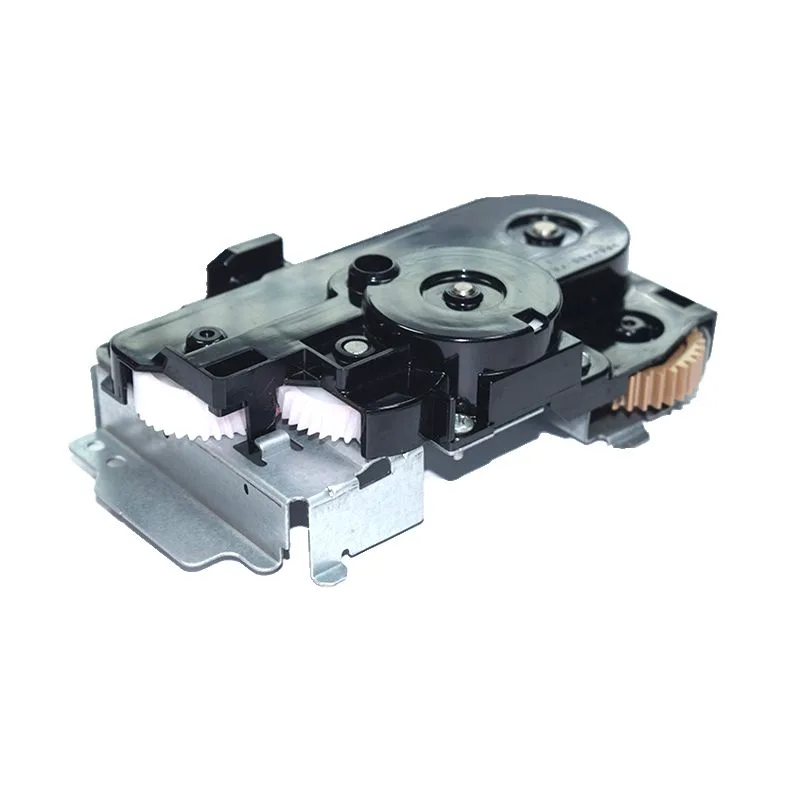
Gear failures round out the list. The drive gear on the developer unit meshes with the fuser drive on the M6500 and M7100 chassis. Molded gears with recycled resin strip teeth under load, especially when a customer jams the machine and forces the drive. You'll hear a rhythmic clicking before the unit stops turning entirely.
Inspection Points Before You Accept a Shipment
Ask your supplier for the coating spec and the cure temperature, not just the page yield. A legitimate developer unit lists sleeve coating type (resin or PTFE-blend), coating thickness in microns, and the triboelectric charge range. If your supplier can't produce those numbers, they're rebranding someone else's reject stock.
On incoming QC, pull at least three units per pallet and check the sleeve under a loupe at the edges — that's where coating wear shows first. Run a finger along the doctor blade edge; it should feel uniform with no nicks or burrs. Weigh the unit. Underweight units usually mean less carrier, which shortens life. And check the seal kit: the foam should be pliable, not compressed flat, and the mylar flap should sit flush against the sleeve.
For the M7100 and BM5100 series, verify the gear tooth profile against an OEM sample. Counterfeit gears often have a slightly different module, which runs quiet on the bench but strips in the field. A simple mesh test with an OEM drive gear catches this in seconds.
Selection Criteria That Separate Good Units From Returns
Match the developer unit to the exact machine family and firmware generation. Pantum changed the developer bias voltage on later M6500 firmware, and units built to the older spec produce lighter print on updated machines. Your supplier should know which revision they're shipping and label the box accordingly.
Carrier type matters more than most buyers realize. Pantum OEM uses a ferrite carrier with a specific particle size distribution. Aftermarket units using recycled or undersized carrier charge inconsistently, which shows up as density variation across the page. Ask for the carrier batch and particle size range.
Packaging is a real selection criterion. Developer units ship with a protective cover and a shipping lock. Units packed loose in a poly bag arrive with shifted carrier and a deformed doctor blade. If your supplier ships without the lock, expect a 5–10% DOA rate.
Here's a short pre-order checklist worth keeping on hand:
- Coating spec and cure temperature documented
- Doctor blade gap within 0.35 mm (P2500) or OEM spec
- Carrier particle size range and batch number
- Seal kit pliability and mylar flap alignment
- Gear tooth profile matched to OEM sample
Why Factory-Direct Supply Changes the Economics
Most Pantum developer unit failures trace back to one of two things: a supplier who doesn't control the coating process, or a trading company that never opens a box. Buying factory-direct removes the middle layer where spec drift happens. You get the coating line, the cure oven, and the QC records in one place.
CLONER manufactures developer units for the Pantum P2500, M6500, M7100 and BM5100 families on our own tooling, with OEM and ODM programs for buyers who need private-label packaging or a modified spec for a specific firmware revision. We hold the coating and carrier specs on file per batch, and we ship every unit with the shipping lock and protective cover installed. For importers running their own brand, we can match your label, your box, and your warranty terms.
If you're currently absorbing developer unit returns on Pantum machines, send us a failed unit and a target price. We'll tell you which spec point is failing and quote a factory-direct replacement that holds up past 40,000 pages.
Need a quote or samples from CLONER?
Factory-direct OEM/ODM supplier of compatible printer consumables & spare parts. Tell us your models — reply within 24h.